Loading...
Please wait while we load the content
Legal Disclaimer: This content is for informational purposes only and does not constitute legal advice. For specific legal guidance, please consult with a licensed attorney.
Please wait while we load the content
Learn legal advice basics, understand your rights, avoid costly mistakes, and navigate the US justice system confidently with clear, beginner-friendly guidance.
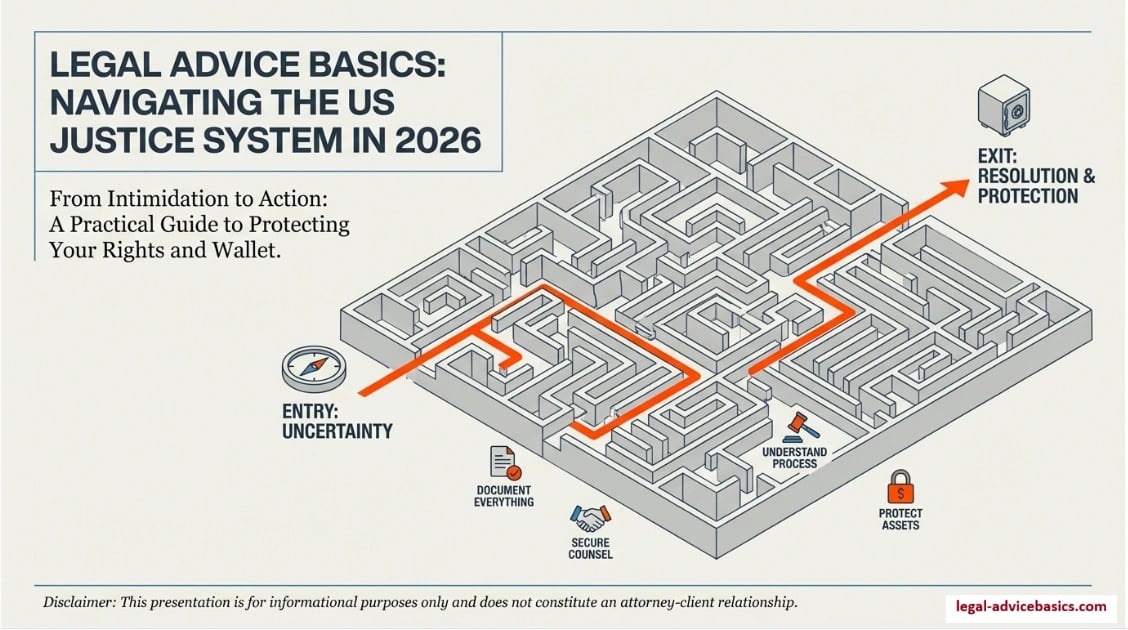
Whether you’ve just been served with a lawsuit, are going through a messy divorce, or simply need to review a confusing contract, the world of law often feels like a maze designed to confuse you. You probably have a hundred questions racing through your mind right now:
Do I really need a lawyer? Can I actually afford one? What happens if I say the wrong thing? The fear of the unknown—and the worry of draining your bank account—can be paralyzing.
Take a deep breath. You are in the right place. This guide covers the essential legal advice basics you need to navigate the US justice system with confidence in 2026. We aren’t just throwing complex definitions at you; we are breaking down the real costs, explaining your fundamental rights, and showing you exactly how to find help—even if you have zero budget.
Disclaimer: I am not an attorney, and this article is for informational purposes only. It does not constitute an attorney-client relationship. For specific legal trouble, always consult a licensed professional.
What Exactly Is Legal Advice? (It’s Not What You Think)
Most people assume that finding a statute on Google or asking an AI chatbot a question counts as legal advice. It doesn't.
In the digital age of 2026, we have instant access to laws and forms. However, distinguishing between Legal Information and Legal Advice is the single most important step to protecting yourself.
Think of the legal system like a complex highway.
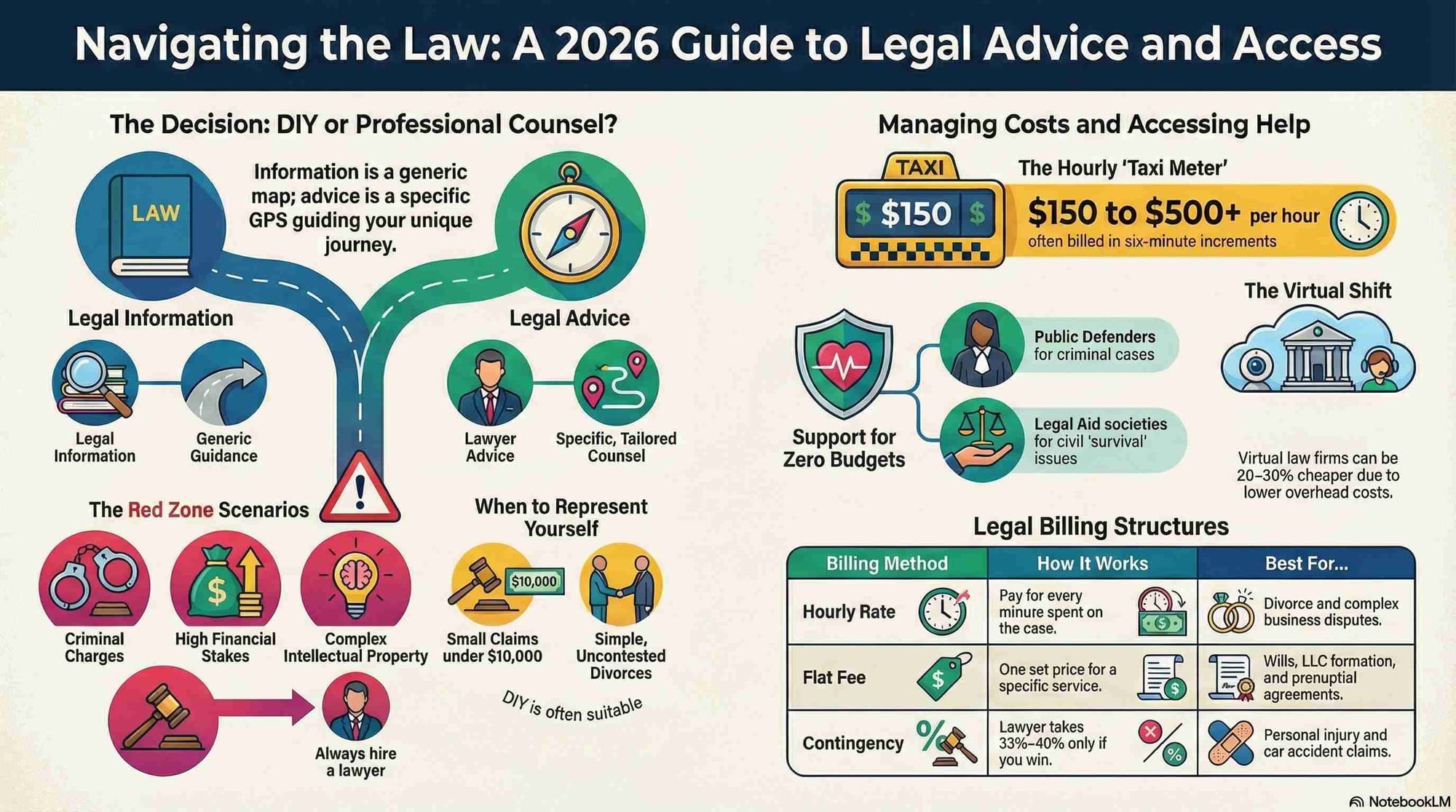
Legal Information is a Map: It shows you all the roads, speed limits, and exit signs. It is generic and applies to everyone.
Legal Advice is a GPS: It tells you exactly which turn to take right now to avoid a crash, based on your specific location and destination.
A map (Information) can tell you a road exists. Only a GPS (Advice) can tell you that the road is closed today and guide you to a safer route.
The Breakdown: Advice vs. Information
Here is a clear comparison to help you distinguish between the two:
Feature | Legal Information (Generic) | Legal Advice (Specific) |
The Source | Websites, blogs, court clerks, AI tools. | A licensed attorney. |
What It Does | Tells you what the law says. | Tells you how the law applies to YOU. |
Liability | You are responsible for any mistakes. | The lawyer is liable (malpractice) if they give bad advice. |
Example | "The statute of limitations is 2 years." | "You must file your lawsuit by this Friday or you will be barred forever." |
Key Takeaway: The rule of thumb is simple. If a website tells you how to file a form, that is just information. If someone tells you which form to file to win your specific case, that is advice. Only a lawyer can safely give you the latter.
Not every legal hiccup requires a $400-an-hour attorney. Sometimes, hiring a lawyer is like calling a SWAT team for a noise complaint—expensive and overkill. But other times, it is the only thing standing between you and disaster.
To make the right choice, use this Decision Matrix. You must weigh the Complexity of the case against the Cost of Losing.
In these scenarios, the cost of making a mistake is far higher than the lawyer's fee. These are "Red Zone" situations.
Risk of Jail Time (Criminal Charges):
The Reality: If your freedom is on the line, never represent yourself. Whether it’s a DUI or a felony, prosecutors are trained experts whose job is to convict you.
The Rule: You need a professional to protect your constitutional rights. If you can't afford one, use a Public Defender.
High Financial Stakes or Complex Assets:
The Reality: Lawsuits involving your home, business equity, or significant damages (e.g., severe car accidents).
The Rule: Think of legal fees here as an investment. It is better to pay $5,000 to protect $200,000 than to lose it all due to a filing error.
The Opposing Party Has a Lawyer:
The Reality: This creates an immediate power imbalance.
The Rule: If you go alone against a lawyer, you are bringing a knife to a gunfight. They know procedural tricks to get your case dismissed before you even tell your side.
Complex Paperwork (Mergers, Patents, Estates):
The Reality: Areas like Intellectual Property or Corporate Law require extreme precision.
The Rule: One checked box in the wrong place can invalidate a patent or contract years later. You are paying for accuracy, not just advice.
The US justice system has specific "lanes" designed for regular people to navigate without a law degree (appearing Pro Se).
Small Claims Court Cases:
These courts are built for disputes under a certain limit (usually $5,000–$10,000 depending on your state). The process is simplified, and judges often discourage expensive lawyers because they defeat the purpose of "small claims."
Simple Traffic Tickets:
If you are fighting a minor speeding ticket or parking violation—and your license isn't at risk of suspension—you can often negotiate the fine yourself. The lawyer's fee would likely exceed the ticket cost.
Uncontested, Simple Divorce:
If you and your spouse agree on everything (splitting assets, no alimony) and there are no children involved, you can often use court-provided "Summary Dissolution" forms to finish the process cheaply.
Pro-Tip: The "Hybrid" Approach You don't always have to choose between "Full Representation" and "DIY." Look for lawyers who offer "Unbundled Legal Services." This means you pay them just to review your DIY paperwork for one hour (approx. $200-$300) to catch mistakes before you file, without hiring them for the whole case.
This is the question everyone is afraid to ask: "Is $400 an hour normal, or am I being ripped off?"
In 2026, the short answer is: It depends on your zip code. While the national average hovers between $150 and $500+ per hour, a top-tier corporate attorney in New York City might charge $1,000/hour, while a family lawyer in rural Ohio might charge $200.
However, the "hourly rate" is just one piece of the puzzle. Understanding how the bill is calculated is just as important as the rate itself.
Lawyers don't just sell time; they sell results. Here is how the four most common billing structures work so you don't get sticker shock.
Hourly Rate (The "Taxi Meter")
How it works: You pay for every minute the lawyer spends working on your case. This is standard for divorce, criminal defense, and complex business disputes.
The "Gotcha" (The 6-Minute Rule): Most lawyers bill in "0.1 hour" increments (6 minutes). If they read your email for 2 minutes, you get billed for 6. If they answer a 4-minute phone call, that’s another 6 minutes.
Money-Saving Tip: Consolidate your questions into one email rather than sending ten separate ones. It saves billable time.
Flat Fee (The "Menu Price")
How it works: One set price for a specific service. This is common for predictable tasks like writing a Will ($300 - $1,000), drafting a Prenup, or forming an LLC.
Why it’s good: You know exactly what you are paying upfront.
The "Gotcha": Ensure the agreement defines the "scope." Does that fee include revisions? What if the government rejects the filing? Always ask what is excluded.
Contingency Fee (The "No Win, No Fee" Model)
How it works: You pay $0 upfront. If you win, the lawyer takes a percentage of the settlement (usually 33% to 40%). This is standard for Personal Injury (car accidents, slip and fall).
The "Gotcha" (Costs vs. Fees): Even if the lawyer waives their fee (their time), you might still be responsible for court costs (filing fees, medical records, expert witnesses).
Critical Question: Always ask, "Are costs deducted before or after the percentage is taken?" Deducting costs before the split puts more money in your pocket.
Retainer Fee (The "Prepaid Debit Card")
How it works: A retainer is not an extra cost; it is a down payment. You pay a lump sum upfront (e.g., $3,000) into a trust account.
The Mechanism: As the lawyer works, they "earn" the money and move it from the trust account to their business account.
Replenishing: Once the account hits $0 (or a set minimum), you must deposit more money to
Want a detailed breakdown? Read our guide on Lawyer Hourly Rates 2026: State-by-State Guide.
If your bank account is empty, you still have rights. However, the US legal system has a strict dividing line: Criminal vs. Civil.
The Constitution guarantees you a lawyer if you might go to jail, but it guarantees nothing if you are simply being sued for money. Here is how to navigate the safety nets based on your specific situation.
Best For: Criminal charges (Felonies, Misdemeanors) where jail time is a potential penalty.
The Rule: Under the 6th Amendment (Gideon v. Wainwright), the government must provide an attorney if you cannot afford one.
How to Get One: You usually cannot call a Public Defender’s office in advance. You must appear at your first court date (Arraignment) and tell the judge: "I cannot afford an attorney and would like to apply for a Public Defender."
Misconception Buster: Don't assume Public Defenders are "bad" lawyers because they are free. In reality, they are often the most experienced trial lawyers in the courthouse. They know the prosecutors and judges better than expensive private attorneys—they are just incredibly overworked.
Best For: Non-criminal "survival issues" (Eviction, Domestic Violence, Food Stamps/Benefits, Immigration).
The Rule: These are non-profit organizations funded by the government (Legal Services Corp). They are income-based (usually for households earning less than 125% of the federal poverty level).
The Reality (The "ER" System): Because funding is tight, Legal Aid acts like an Emergency Room. They perform "triage." They might turn away a consumer debt case to prioritize a victim of domestic violence who is in immediate physical danger.
Action Plan: Google "Legal Aid [Your County]". When you call, have your pay stubs and court notices ready. If you don't qualify for full representation, ask if they have "Self-Help Clinics" to teach you how to fill out the forms yourself.
Best For: Civil cases where you fall into the "Gap"—you earn too much for Legal Aid, but too little for a private lawyer.
The Rule: "Pro Bono" means a private lawyer works for free as a public service.
How to Find It: Do not cold-call law firms asking for free work; you will likely be rejected. Instead, contact your state’s Bar Association. They maintain a list of vetted pro bono referral programs that match clients with volunteer lawyers.
Hidden Gem: Law School Clinics If you live near a university with a Law School, check if they have a "Legal Clinic." Here, 3rd-year law students handle real cases (like housing disputes or small business setups) for free under the strict supervision of expert professors. They are eager to learn, incredibly thorough, and often put more time into a case than a busy professional would.
Check our full list of Top 10 Free Legal Advice Hotlines & Charities
It's 2026. You don't always need to take a day off work, put on a suit, and drive to a mahogany-paneled office to get a simple answer.
The rise of Virtual Legal Services has made getting answers faster and cheaper. But to save money without losing your rights, you must know the difference between a Tool and a Lawyer.
The Shift: Instead of paying for expensive downtown office rent, many lawyers now operate as "Virtual Firms" using secure video links (Zoom/Teams).
The Value: Because their overhead is lower, their hourly rates are often 20-30% cheaper than traditional firms for the exact same quality of work.
How to Find Them: Search for "Virtual Law Firm [Your State]". (Note: They must still be licensed in your specific state).
Platforms: JustAnswer, Avvo, LawGuru.
Best For: Quick "Sanity Checks" (e.g., "Is this landlord notice legal?" or "What is the fine for this ticket?").
The Cost: Usually a small fee ($5 - $50) to chat with a verified lawyer.
⚠️ The "Subscription Trap" Warning:
Be careful with sites like JustAnswer. They often advertise a "$5 trial" for one question but automatically enroll you in a $46+/month subscription if you don't cancel immediately. Always read the fine print on the payment page.
Platforms: Rocket Lawyer, LegalZoom.
Best For: Standard paperwork where the blanks are easy to fill (LLC Formation, Leases, Simple Wills).
Which One to Choose?
Rocket Lawyer: Best for a Subscription model (approx. $40/mo). Ideal if you need ongoing help (e.g., a small business owner needing 5 contracts a month).
LegalZoom: Best for One-Time purchases. Ideal if you just need a single document (like a Will) and nothing else.
While these digital tools are powerful, they come with a massive warning label: They cannot represent you in court.
The AI Risk ("Hallucinations"): In 2026, it is tempting to ask an AI to "write a contract." Don't. AI can invent laws and court cases that don't exist. Use AI to summarize documents, never to draft them.
The "Pro Se" Trap: If you use an app to prepare your divorce papers, you are technically representing yourself (Pro Se). The judge expects you to know the rules of evidence, regardless of which software you used.
The Digital Rule of Thumb: Use apps to prevent problems (contracts, forms, filings). Use humans to solve problems (lawsuits, arrests, plea deals).
(Note: We use clear, direct answers here to help you find what you need fast.)
What are the 5 C's of attorney-client privilege?
The 5 C's are the checklist to keep your secrets safe.1 Generally, they are:
Communication: It must be a verbal or written exchange.
Confidential: It must happen in private (no friends or strangers in the room).
Client: You must be seeking advice as a client (even if you haven't paid yet).
Counsel: The person must be a licensed lawyer.
Claim: You must claim the right to keep it secret.
What is NOT covered by attorney-client privilege? (Rule 1.6)
The biggest exception is the Future Crime/Fraud rule. If you admit to a past crime ("I robbed a bank"), it is privileged. If you ask for help to commit a future crime ("Help me hide this stolen money" or "I am going to hurt a witness"), the lawyer is legally required to report you.
What destroys attorney-client privilege?
The presence of a Third Party. If you bring your best friend or mother into the meeting for moral support, the privilege is broken.2 The law assumes that if you told someone else, it wasn't a secret.
What not to say to your attorney?
Never lie about the facts. However, do not tell them, "I plan to lie on the stand." If a lawyer knows you intend to commit perjury, they ethically cannot let you testify.
Is $400 an hour a lot for a lawyer?
It depends on the location. In major cities (NY, LA), $400 is standard for an experienced attorney. In rural areas, it is high. Remember: A $400/hr expert who solves the problem in 1 hour is cheaper than a $100/hr novice who takes 10 hours.
Why do lawyers take 33% of a settlement?
This is the Contingency Fee model. The lawyer takes 100% of the financial risk—working for months with $0 pay. If they lose, they get nothing. The 33% is their reward for funding your lawsuit upfront.
How much of a $25,000 settlement will I actually get?
Roughly $11,000 - $14,000. Here is the math:
Total: $25,000
Minus Lawyer Fee (33%): -$8,250
Minus Costs (Filing fees, Medical Records): ~$2,000
Minus Medical Liens (Bills you owe): ~$3,000 (Varies)
Your Check: ~$11,750.
Do lawyers make $500,000 a year?
Most don't. While partners in top "Big Law" firms earn millions, the average lawyer in the US makes between $130,000 and $160,000. Public defenders often earn significantly less.
Can I call a lawyer to ask questions for free?
Yes and No. Most lawyers offer a "Free Consultation," but this is a job interview to see if they want to take your case. They will not give you specific legal advice to handle the case yourself during this call.
What exactly is legal advice vs. information?
Information: "The speed limit is 65mph." (Generic fact).
Advice: "Plead not guilty because the radar gun wasn't calibrated."3 (Specific strategy for YOU).
Is online legal advice trustworthy?
It is good for Triage (figuring out if you have a problem), but bad for Surgery (fixing the problem). AI chatbots can "hallucinate" laws that don't exist.4 Always verify online info with a local professional.
What's it called when you can't afford an attorney?
In legal terms, you are considered "Indigent." This status may qualify you for a Public Defender (in criminal cases) or a waiver of court filing fees (in civil cases).
Use these search terms to find free help in your area:
If You Need... | Search For / Do This... |
Free Legal Advice Hotline 24/7 | Call 2-1-1 (United Way). Avoid commercial "hotlines" that are just ads. |
Charities for Legal Fees | Search for "Legal Aid Society [Your County]" or "Modest Means Program." |
Renters Rights / Eviction | Google "Tenant Union [Your City]" or "Housing Justice Project." |
Legal Paperwork Help | Visit the "Self-Help Center" inside your local Family Courthouse. |
Local Legal Services | Search for "Pro Bono Referral Program [Your State Bar]." |
If you take only one thing from this guide, let it be this: The worst legal strategy is silence.
Many people believe that if they ignore a scary legal letter or refuse to answer the door for a process server, the problem will disappear. It won’t. In the US justice system, ignoring a lawsuit triggers a Default Judgment.
This means because you didn't show up to tell your side, the judge automatically declares the other side the winner. They can then start garnishing your wages or freezing your bank accounts without you ever stepping foot in a courtroom.
Now that you understand the legal advice basics, your next step is to stop worrying and start moving.
Don't stay paralyzed. Choose the path that fits your situation right now:
Need a quick answer?
👉 Use a verified [Online Legal Chat] or Q&A site. It’s the cheapest way to get a "sanity check" and sleep better tonight.
Facing a lawsuit?
👉 Search for a Local Attorney immediately. The clock is already ticking on your response deadline, and you don't want to lose by default.
Short on cash?
👉 Contact your local Legal Aid Society or visit the Self-Help Center at your courthouse. You have rights, regardless of your budget.
Final Thought: The law rewards those who are prepared. You don't need to know every statute; you just need to know where to find help. Knowledge is your best defense. Stay informed, stay calm, and take action.
Legal Advice Basics Team
Contributing writer at Legal Advice Basics, focusing on making legal concepts accessible to everyone.
Legal Disclaimer
This article is for informational purposes only and does not constitute legal advice. Laws vary by jurisdiction and individual circumstances. Always consult with a qualified attorney for advice specific to your situation.